Understanding Me
In my final year of high school, circa 2016, one of my friends recommended I take a personality test. It was more like insisted, because he had just learned about the Myers-Briggs Type Indicator (MBTI) and wanted to get absorbed in it. Long story short, I took the test and got my results: INTP. He was ecstatic, telling me that I got one of the rarest types and started breaking down the type and its meaning.
Fast forward to today; I retook the test again to see if anything had changed. Well, not that much changed. I say not much because new additions have been added to the MBTI system, specifically another letter at the end.
Typically, there are 4 letters that represent different aspects of our personality: Mind (I or E), Energy (N or S), Nature (T or F), and Tactics (J or P). However, new studies have added a new aspect: Identity (-A or -T).
The results of my new test were pretty much the same, but with the new addition, it became: INTP-A — the Logician.
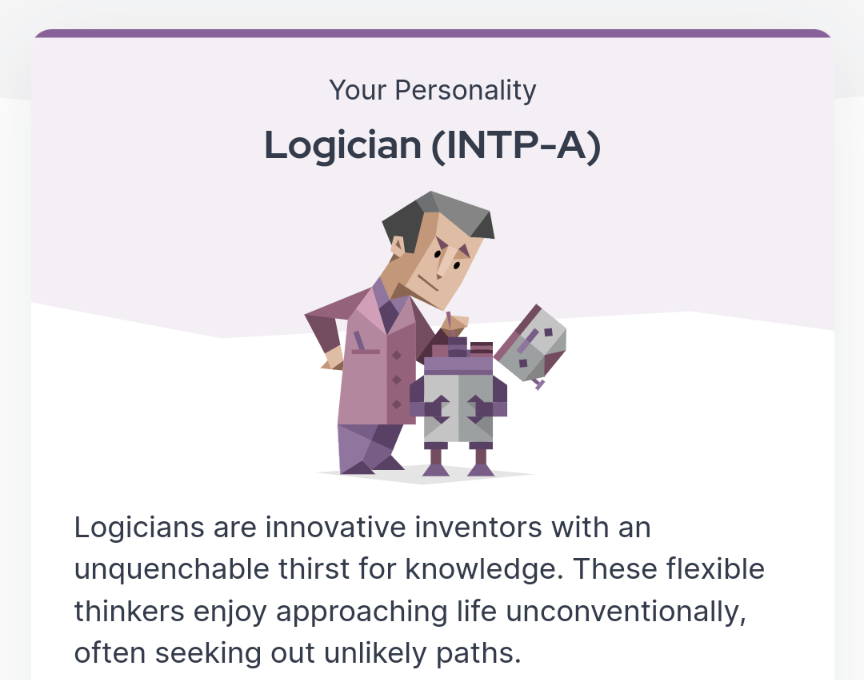
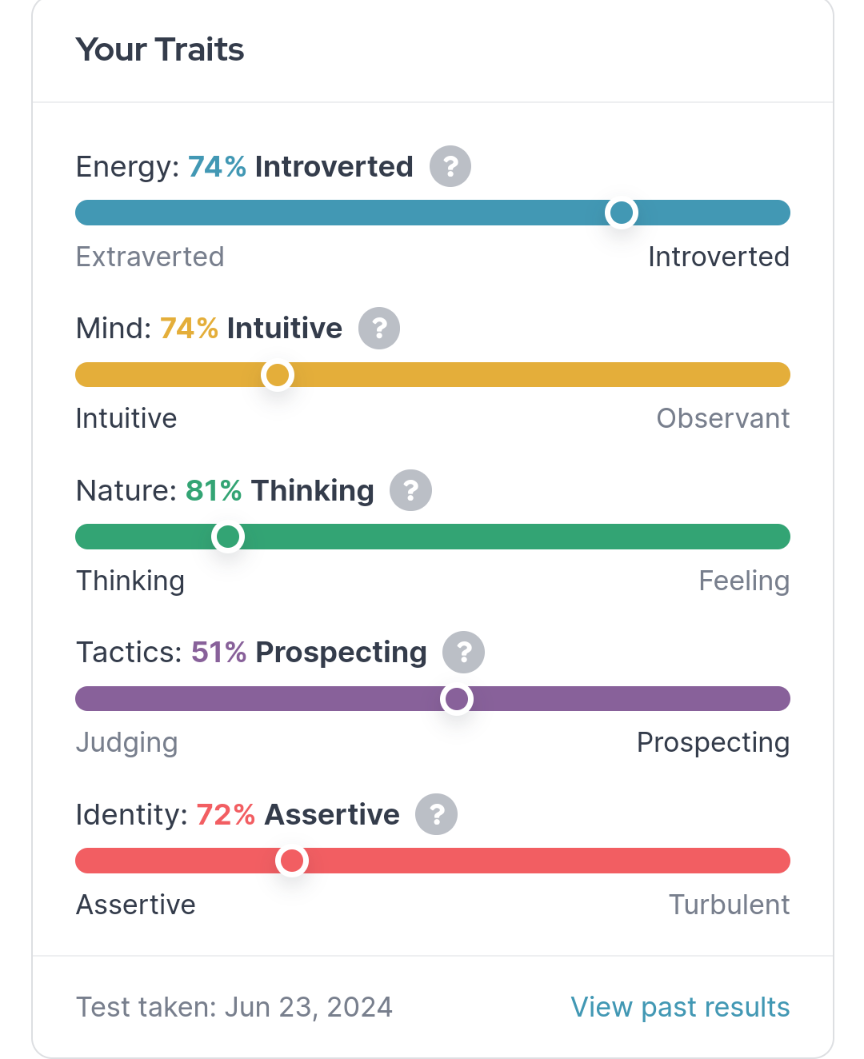
So, let’s explore what this acronym means.
Five Personality Aspects
Mind: (I)ntroverted
The Mind aspect refers to our level of expressiveness and the degree to which we seek external stimulation (people, objects, and activities). This also correlates to other personality traits, such as willingness to volunteer, desire to engage in thrill-seeking activities, and romantic assertiveness, to name a few. At the two ends of this scale lies: (I)ntroverted and (E)xtraverted.
(I)ntroverted people are reserved, quiet, and more comfortable alone. They are energized by spending time alone and connecting with their own world.
They do not seek much external stimulation and requires less communication with others. This preference for less stimulation can also influence their hobbies, political attitudes, and even eating or drinking habits.
(E)xtraverted people are expressive, outgoing, and comfortable around people. They are energized by engaging with people and the external world.
Logicians are introverted people. We love being self-sufficient, enjoy working with ideas rather than people, and don’t need large friend circles. Socializing tends to deplete our internal energy reserves rather quickly, forcing us to retreat into our home bases to recharge.
This doesn’t mean that all Logicians are the same. Some of us are quite capable of socializing. Most of the time, however, we develop our social skills out of necessity, not enthusiasm.
Energy: I(N)tuitive
The Energy aspect relates to how we see the world and what kind of information we focus on. At the two ends of the scale lies: I(N)tuitive and Ob(S)ervant.
It’s important to remember that this aspect has nothing to do with how information is absorbed — both types use their sense equally well. Instead, it shows whether we focus on what is possible (making connections intuitively) or what is real (observing the environment).
I(N)tuitive people tend to be visionaries, meaning they are interested in ideas and abstractions and are attracted to novelty.
They rely on their imagination and think in terms of possibilities. They dream, fantasize, and question why things happen the way they do, always feeling slightly detached from the concrete world. They do observe people and events. However, their minds remain directed inwards — always questioning, wondering, and making connections. All things considered, they believe in novelty, in the open mind, and in never-ending improvement.
Ob(S)ervant people tend to prefer facts, concrete and observable things, and the tried and true. They focus on the actual world and things happening around them. They are also significantly better at focusing on just one thing at a time instead of juggling multiple activities.
Logicians are intuitive people. This makes us good at seeing possibilities and honoring different points of view. We are not that concerned with what is happening; instead focusing on what might happen or why something has happened. We hone this focus throughout our lives, making us passionate and insightful thinkers.
Our focus in novelty and change does, however, come at a cost. By directing our mental resources toward possibilities and the future, we inevitably lose sight of what is happening around us. We may have difficulties dealing with practical matters or data. Without paying attention, we may even miss something right under our noses. Because majority of the population has the Observant traits, we may have difficulty finding a partner and connecting with others.